
More cause for optimism
I was about to resume whining

After several posts where optimism reigned, I was all set for a reality check. I was going to complain about a self-styled EL advocate who doesn’t understand fundamentals of reading pedagogy, for example, referring to orthographic mapping as “the technical term for decoding” and misinterpreting the neuroscientist Stanislas Dehaene as advocating teaching readers to go from the visual image of a word right to its meaning, bypassing phonology. Then I was going to complain about a noisy whole language advocate polluting discussions about teaching reading by posting lampoons and childishly name-calling people with whom he disagreed.
But something happened on the way to my whine-fest.
First came a reported sighting of Lucy Calkins at the recent Reading League summit.
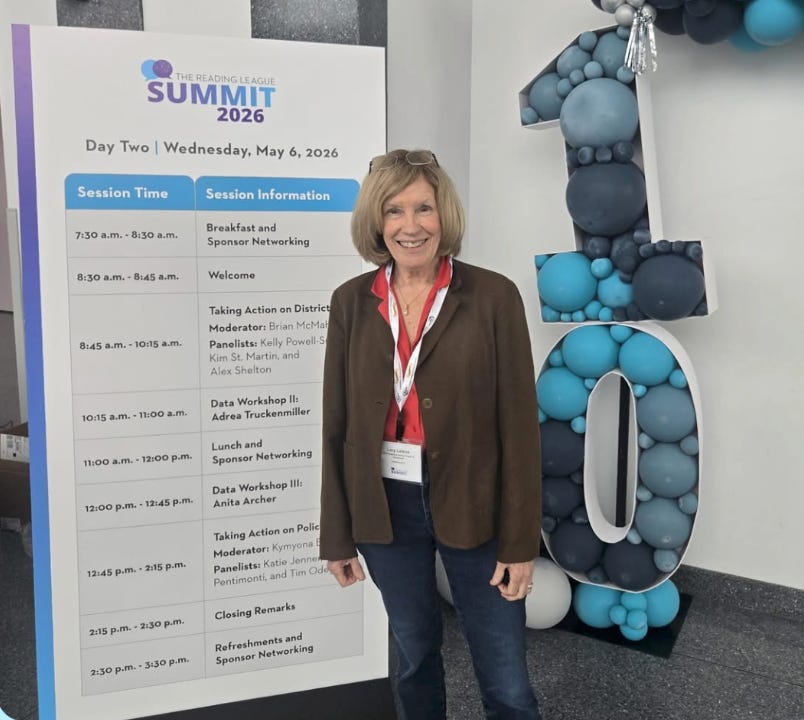
Yes, that Reading League, which is all about “The Science of Reading,” where phonics and foundational skills play a prominent, but by no means exclusive, role in reading instruction. And yes, that Lucy Calkins who a few years ago took exception to “the phonics-centric people who are calling themselves ‘the science of reading.’” Maybe she had The Reading League in mind. I don’t know.
In any case, speaking of whines, Lucy Calkins and The Reading League are not a common pairing. Yet here they were. And documented by Dr. Calkins herself as shown in this Facebook post with a very warm and generous note.
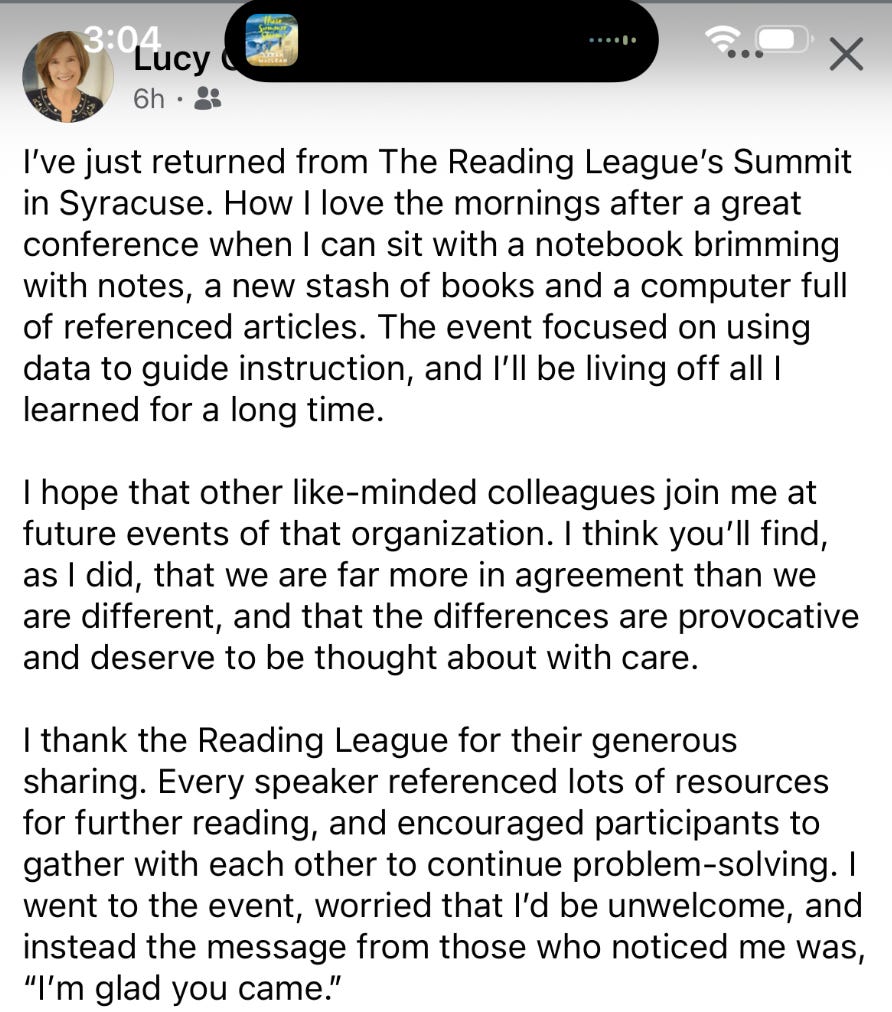
No need for any comment from me. The post speaks for itself, although I’ll acknowledge there are cynics who doubt its sincerity, just as I found after writing a post about Linda Darling-Hammond’s endorsing “the science of reading” as an element in Mississippi’s dramatic improvement in reading achievement. In backchannel notes and comments on the post, I heard the skepticism loud and clear. I understand, and the cynics might be right.
But the fact is that Drs. Darling-Hammond and Calkins have written what they’ve written, and I’m willing to believe they mean what they wrote. I’m particularly gratified by this in the Calkins Facebook post:
I hope that other like-minded colleagues join me at future events of [The Reading League]. I think you’ll find, as I did, that we are far more in agreement than we are different, and that the differences are provocative and deserve to be thought about with care.
Then the second heartening thing was a report I just found out about that came out last year. I’d never encountered it until it was forwarded to me by Kari Kurto of (again!) The Reading League.
This one is somewhat closer to home for me: The Science of Reading and Dual Language Education: Supporting Multilingual Learners’ Language and Literacy Development, written by Xigrid Soto-Boykin, Gladys Aponte, and Shantel Meek of the Children’s Equity Project at Arizona State University.
It was, to say the least, an eye-opener. As with the articles I discussed in my last post, maybe we ARE turning a corner.
Far from the unhelpful negativity of the National Committed for Effective Literacy (NCEL) and assorted other mis-leading and mis-informative pieces (see, e.g., here and here), Soto-Boykin and colleagues are joining others[1] in casting the “science of reading” (or my preferred term, “literacy research comprehensively understood”) in a far different relationship with English Learners (or Multilingual Learners). Rather than a scourge to be battled or at a minimum ignored, the “science of reading” (“literacy research comprehensively understood”) should be seen as a source of useful and important understanding for those interested in improving literacy outcomes for ELs or anyone for that matter.
I encourage everybody who cares about the literacy futures and presents of ELs to read the entire report and share it widely. Here are a few choice quotes, because… because I can’t resist.
There is a robust research base that should inform how we teach children to read, referred to broadly as the Science of Reading. Literacy instruction aligned with SOR is associated with improved reading skills, enhanced comprehension, increased reading enjoyment, earlier identification of dyslexia, and better academic performance. (The Science of Reading and Dual Language Education, p. 4)
Bringing together DLE [dual language education] with science-based reading instruction can optimally support emergent bilingual children and help bridge gaps between them and their peers on reading outcomes. (The Science of Reading and Dual Language Education, p. 4)
Our report concludes with a number of high level policy recommendations at all levels including expanding access to high quality DLE, prioritizing emergent bilingual children; increasing the quality and scope of SOR policies and implementation guidance to more fully capture the needs and support systems required to support early literacy; improving reading assessment - especially for bilingual children; and supporting workforce development for all teachers and aides working with early grade students. (The Science of Reading and Dual Language Education, p. 7)
The Science of Reading (SOR) refers to the multidisciplinary, multilingual decades-long body of research on how children become fluent readers. For children to become fluent readers, they need to decode texts and comprehend what they read. Instruction aligned with SOR principles is comprehensive, including both decoding (e.g., alphabetic principle, phonological awareness, phonics, etc.) and listening comprehension (e.g., oral language and vocabulary, background knowledge, awareness of sentence structures, literary genres and text structures, etc.). Skillful reading also requires the cognitive underpinnings that facilitate reading comprehension, including working memory and executive functioning skills. (The Science of Reading and Dual Language Education, p. 9)
The major findings of these studies [about multilingual children/emergent bilinguals and the SOR] is that multilingual children benefit from similar types of reading instruction as monolinguals, such as instruction that follows a comprehensive scope and sequence, multiple repetitions, opportunities to practice phonics skills in authentic decodable texts, rich language interactions that help children advance their background knowledge, vocabulary, and oral language, and small group instruction. However, applying the same instructional strategies to multilingual children without considering their language backgrounds is inadequate. (The Science of Reading and Dual Language Education, p. 15)
I can only hope those EL advocates who think they’re working on behalf the students they presume to champion can pay attention to the research and what these reports and articles are telling us. As I’ve asked before, what are the chances?
Sadly not all is quiet on the western or any front. My next post will be a bit of a bummer, I’m sorry to say. I’d better hurry before something good happens or is published again, and I feel compelled to stay optimistic.
[1] See Jonathan Kittle, Steve Amendum, and Christina Budde’s article, “What Does Research Say About the Science of Reading for K-5 Multilingual Learners?”; a report by Sarah Marie Howard from the Center for Applied Linguistics (CAL), “Legislating Literacy Instruction: Where are Multilingual Learners?”; Rafely Palacios’ post on this Substack, “What Works for English Learners: A Journey from Whole Language to Effective Reading Instruction”; Larry Ferlazzo’s Education Week piece, “What the ‘Science of Reading’ Movement Has Meant for English Learners,” featuring commentary from three experienced educators, all EL and dual language education (DLE) advocates; and Alexandra Güílamo’s Language Magazine article entitled “The Best of Both Worlds,” where she “suggests how dual language program leaders can best integrate science of reading legislation” to forge what she calls “bilingual SOR” (p. 26). Imagine that. And this too: “DLE excellence and SOR implementation are not adversaries but partners.”
This post is a double wow. Wow about Lucy Calkins at TRL conference! And wow, what a gem of an article is the "DOR and Dual Language Education" piece! A must-read for sure.
I was at the TRL Summit and spoke briefly with Ms. Calkins. She was lovely. She admitted to having a lot to learn. Don’t we all?!?! We can learn better together and bring the right information into the classroom. We all want better outcomes for our students 😊